Ask any seasoned court contractor about their most disheartening site visits, and they will recount the same story: a tennis club spent tens of thousands of euros on a vibrant new acrylic surface, only to find wide, jagged fissures reappearing straight through the service boxes nine months later. The surface installer was blamed, but the culprit was lurking beneath: unaddressed geotechnical settlement and failed subsurface drainage.
Before committing capital to cosmetic resurfacing, every facility owner must understand how water moves around and beneath their court platform.
Diagnosing Court Cracks: Static vs Working Fissures
Not all cracks are created equal. Knowing how to classify a defect dictates the correct engineering intervention:
| Crack Classification | Root Mechanism | Behavior Over Seasons | Recommended Remediation |
|---|---|---|---|
| Shrinkage Hairline (< 2mm) | Bitumen oxidation and loss of volatiles in aging asphalt. | Stable; does not change significantly between summer and winter. | V-groove routing, cold-pour acrylic elastomeric crack sealant, light mesh. |
| Thermal "Working" Fissure (3mm–15mm) | Concrete expansion joint movement or asphalt thermal contraction cycles. | Opens wide in freezing winter; narrows in hot summer sunshine. | High-elongation multi-layer membrane system (stress-relief interlayer). |
| Settlement / Shear Rupture (> 15mm) | Sub-base washout, uncompacted fill failure, or active tree root intrusion. | Continuous widening accompanied by vertical height offset across the fault. | Full-depth saw cutting, excavation of failed base, aggregate re-compaction, asphalt patching. |
The Membrane Revolution: Why Rigid Mortars Fail
Historically, groundsmen attempted to fix court cracks by trowelling rigid cement mortar or standard epoxy into the gaps. This is an exercise in futility. As soon as winter arrives, the concrete or asphalt slabs contract, generating tens of thousands of pounds of tensile force. The rigid patch cracks immediately along the bond line.
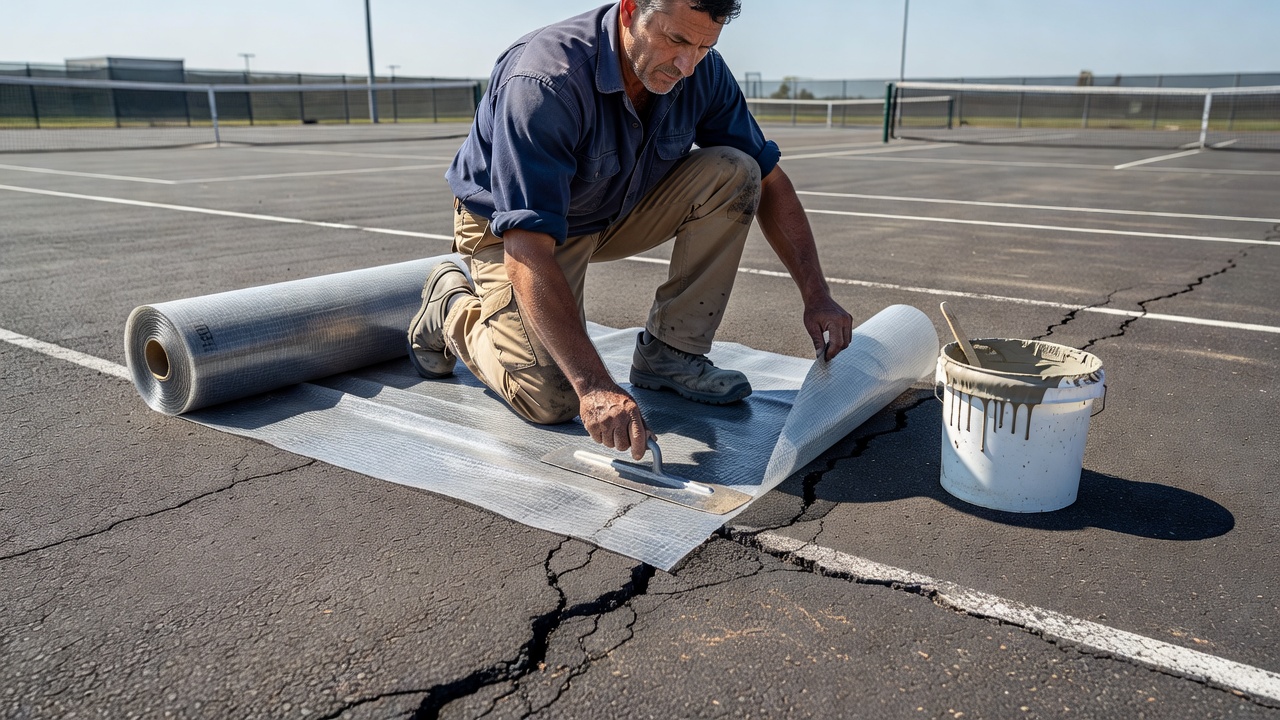
Modern court restoration relies on specialized tension-release membrane systems. These systems utilize a multi-layer composite: a micro-porous slip sheet placed directly over the crack that is unbonded to the crack itself, held down by expandable high-tensile fiberglass mesh saturated with elastomeric acrylic resins. When the underlying slab expands or contracts, the slip sheet allows the crack to move underneath without telegraphing tensile stress through to the top playing surface.
"Treating a structural working crack with rigid filler is like placing plaster over a fractured hinge: the first time the door swings, the plaster turns to dust. You must decouple the movement from the top wearing coat."
Perimeter Drainage & French Drain Installations
Most court settlement problems trace back to water standing against the perimeter kerb. If your court is carved into a gentle hillside—common throughout Central Europe and rolling English countryside—groundwater will flow downhill and saturate the aggregate sub-base beneath the higher court edge.
When this sub-base becomes waterlogged, fine silts wash away, leaving subterranean voids that cause the court edge to sag. In cold regions, saturated sub-bases undergo frost heave, lifting the court edges several centimetres in January and dropping them unevenly during spring thaws.
A comprehensive restoration must include an active perimeter interceptor trench (French drain):
- Excavation: A trench 300mm to 400mm wide and 600mm to 800mm deep dug parallel to the high side of the court.
- Geotextile Lining: Non-woven geotextile fleece lining the trench to prevent surrounding soil from silting up the drainage stone.
- Perforated Pipework: A 110mm slotted twin-wall drainage pipe bedded on clean, washed 20mm pea gravel, laid to a positive fall leading to a storm ditch or soakaway.
- Linear Channel Drains: Along the lower perimeter edge, polymer-concrete slot drains with heel-proof galvanized grates intercept surface runoff before it can pool against the perimeter fence posts.
Dealing with Tree Roots & Subterranean Flora
Majestic mature oak, willow, or poplar trees near tennis courts are notorious for sending exploratory roots straight under the warm asphalt. As roots expand, they exert massive hydraulic lifting force, creating unsightly bumps and dangerous trip hazards. Simply grinding the bump down weakens the asphalt slab and leaves the root intact to regrow within months.
The correct remediation involves: carefully saw-cutting a clean rectangular asphalt section over the affected zone, excavating the root back past the perimeter boundary, severing and treating the stump with professional arboricultural growth inhibitors, inserting a vertical HDPE root barrier sheet (minimum 1.0 meter depth) along the fence line, and re-laying compacted base stone and hot-rolled asphalt wearing course flush with the surrounding grade.