Few upgrades pay for themselves faster than a well-planned lighting retrofit. In many parts of Europe, winter daylight fades before 16:30. Without lighting, a club court sits idle through the lucrative weekday evening hours. Yet, court lighting remains one of the most contentious topics in local town planning meetings, where neighbours worry about light pouring into bedroom windows and ecologists warn about disruption to local bat flight corridors.
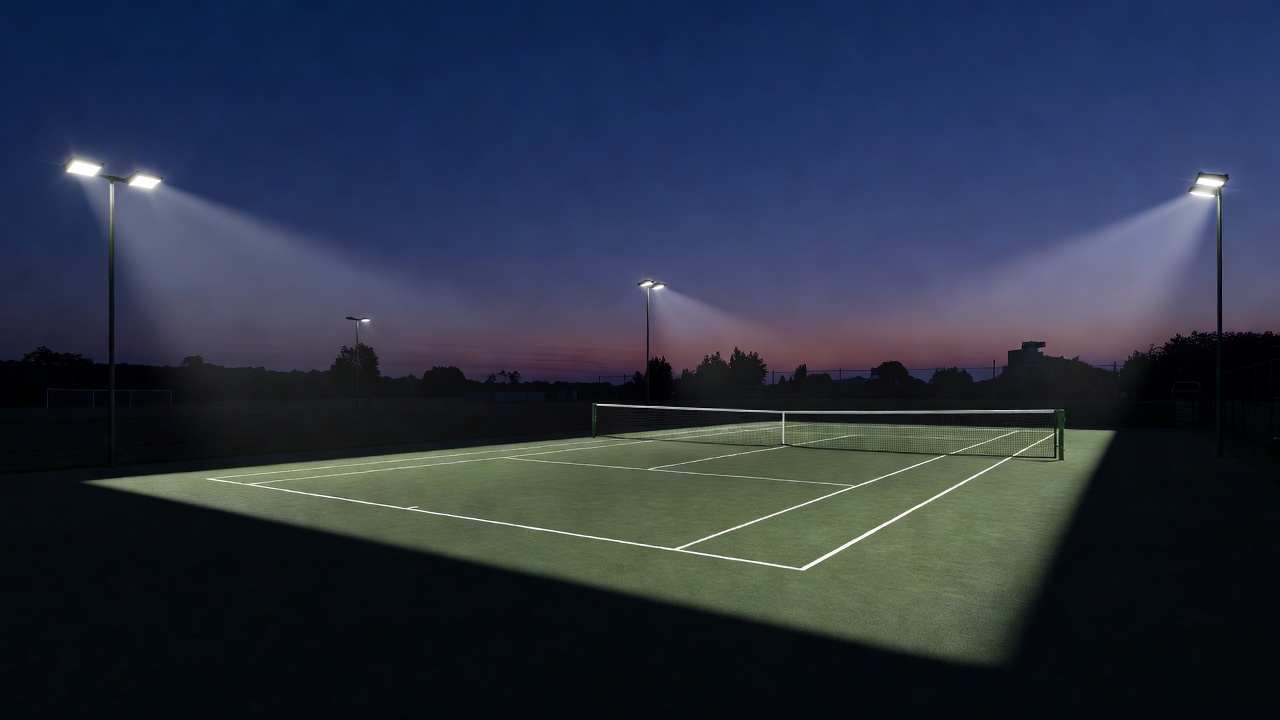
The good news: the days of massive, symmetrical floodlights tilted upward at 45 degrees are over. Modern LED retrofits use flat-glass asymmetric lenses that cast sharp, flat-top distributions down onto the playing surface with near-zero upward light emission (zero ULOR - Upward Light Output Ratio).
Understanding European Sports Lighting Standards (EN 12193)
Before soliciting quotes from electrical contractors, you need to determine which lighting classification matches your facility's level of play under the European standard EN 12193 (Light and lighting - Sports lighting):
| Class Level | Intended Use Case | Maintained Horizontal Illuminance (Eav) | Uniformity Ratio (Emin / Eav) |
|---|---|---|---|
| Class III | Recreational play, beginner coaching, school use | 200 Lux | ≥ 0.50 |
| Class II | Regional club competition, advanced league play | 300 Lux | ≥ 0.70 |
| Class I | National tournaments, high-level competition | 500 Lux | ≥ 0.70 |
Uniformity is even more critical than peak brightness. If the center of the court reads at 400 lux while the deep corners fall to 150 lux, the tennis ball will appear to accelerate or "flicker" as it travels through shadow gradients, throwing off player timing and reaction speeds.
Asymmetric Optics vs Symmetrical Buckets
Traditional floodlights resembled metal buckets that blasted light in all directions. To cover the court, installers tilted them upward, sending stray photons straight into the sky and into adjacent gardens. Modern dedicated sports luminaires sit almost completely horizontal to the ground (zero tilt angle). Inside the fixture, internal precision micro-reflectors and asymmetric prism lenses throw the beam forward across the court at angles of 50 to 65 degrees.
"If you can see the bright yellow LED chips directly when standing three paces behind the perimeter fence, the luminaire is improperly aimed or lacks internal louvres. A well-designed asymmetric installation keeps the light source hidden from residential observers outside the court boundaries."
Evaluating Existing Mast Infrastructure
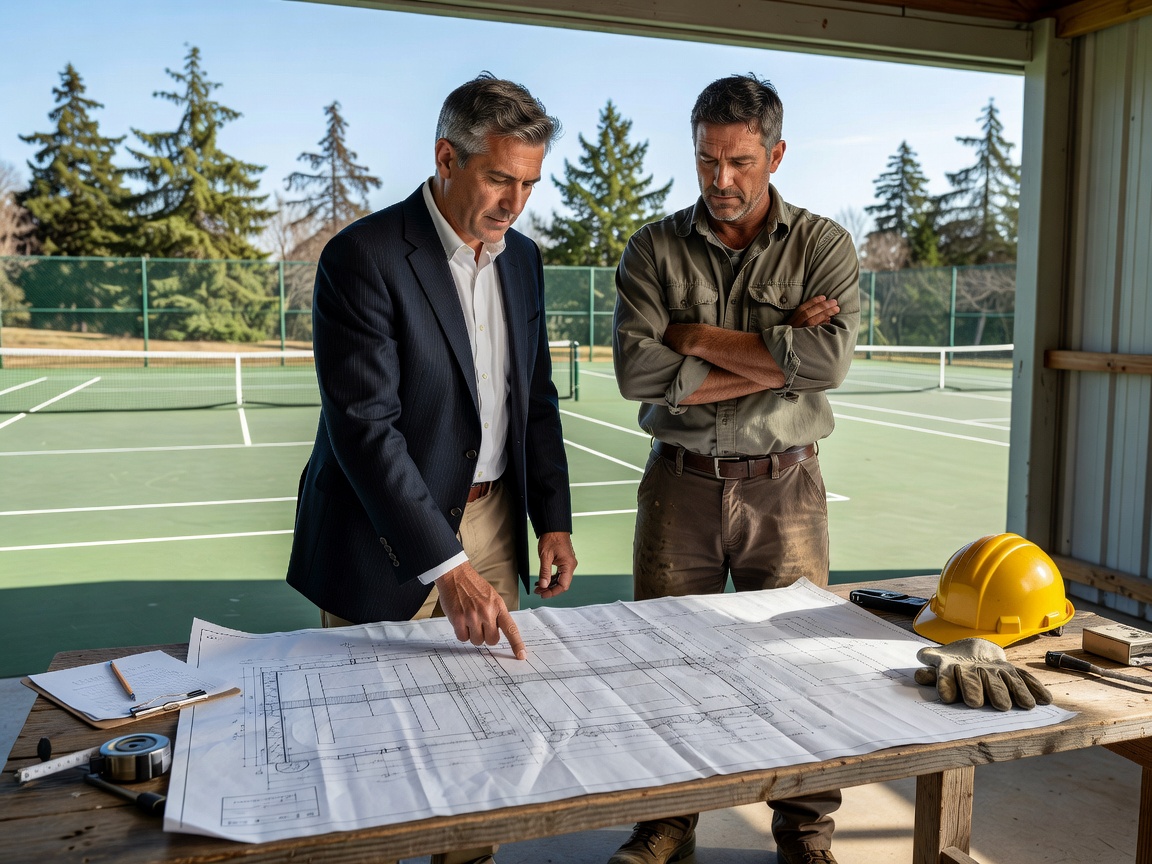
When retrofitting an older installation, committees often ask: Can we keep our existing 6-meter or 8-meter steel masts?
The answer depends on a structural wind-load and weight assessment. While LEDs consume significantly less electrical power, modern heat sinks and driver enclosures are often heavier than the thin aluminium shells of retired halogen fixtures. Furthermore, the wind-sail area (effective projected area, or EPA) of multiple LED heads can overload corroded base plates or cracked concrete foundations. A certified structural inspector should test mast wall thickness with ultrasonic thickness gauges before mounting new hardware.
Smart Control Systems & Energy Payback
One of the biggest operational leaps with solid-state LED lighting is instant on/off switching. Metal halides required warmup periods and cool-down cycles, meaning clubs left lights blazing even during 45-minute booking gaps. With modern LED installations, clubs can deploy smart access controllers:
- PIN-Pad & Mobile Booking Integration: Lights activate automatically two minutes prior to a booked court slot and shut down five minutes after play concludes.
- Two-Tier Dimming: System drops to 150 lux for routine junior practice sessions, ramping to 350 lux only when competitive league matches are scheduled.
- Phase Balancing & Surge Suppression: Quality luminaires incorporate external 10kV to 20kV surge protection devices (SPDs) to shield sensitive drivers from grid spikes and lightning phenomena.