Every tennis club committee has had that awkward annual general meeting: the court surface is flaking, balls slip dangerously on damp green algae, and the treasurer reveals there is barely enough money in the bank to purchase a new case of tournament balls. The committee is forced into contentious special member levies or hasty bank loans.
It does not have to be this way. Tennis court infrastructure has predictable wear cycles. By instituting a structured asset preservation program and establishing an amortized sinking fund, facility owners can manage maintenance as a steady, predictable operational cost rather than an unpredictable financial emergency.
The 10-Year Lifecycle Calendar
A high-quality outdoor court installation in Europe follows a recognized degradation curve. Understanding the stages allows you to intervene at the right moment with minimal capital outlay:
| Operating Year | Primary Physical State | Required Facility Interventions |
|---|---|---|
| Years 1 – 2 | Optimal friction, clean drainage, vibrant line contrast. | Routine leaf blowing, bi-annual biocide treatments, checking net center-strap anchors. |
| Years 3 – 4 | Minor wear in baseline service pockets; subtle moss ingress along shaded edges. | Deep rotary surface washing (low pressure), perimeter drainage channel flush, fence tension check. |
| Years 5 – 7 | Surface texture smoothing in high-traffic zones; micro-hairline crazing on asphalt edges. | Touch-up line marking, elastomeric crack injection, application of single acrylic binder wear coat. |
| Years 8 – 12 | Full color fade, loss of traction in wet conditions, noticeable baseline thinning. | Full resurfacing cycle: mechanical surface prep, birdbath levelling, 2–3 layer acrylic slurry or carpet re-turf. |
Biocide Treatments: The Golden Rule of Porous Courts
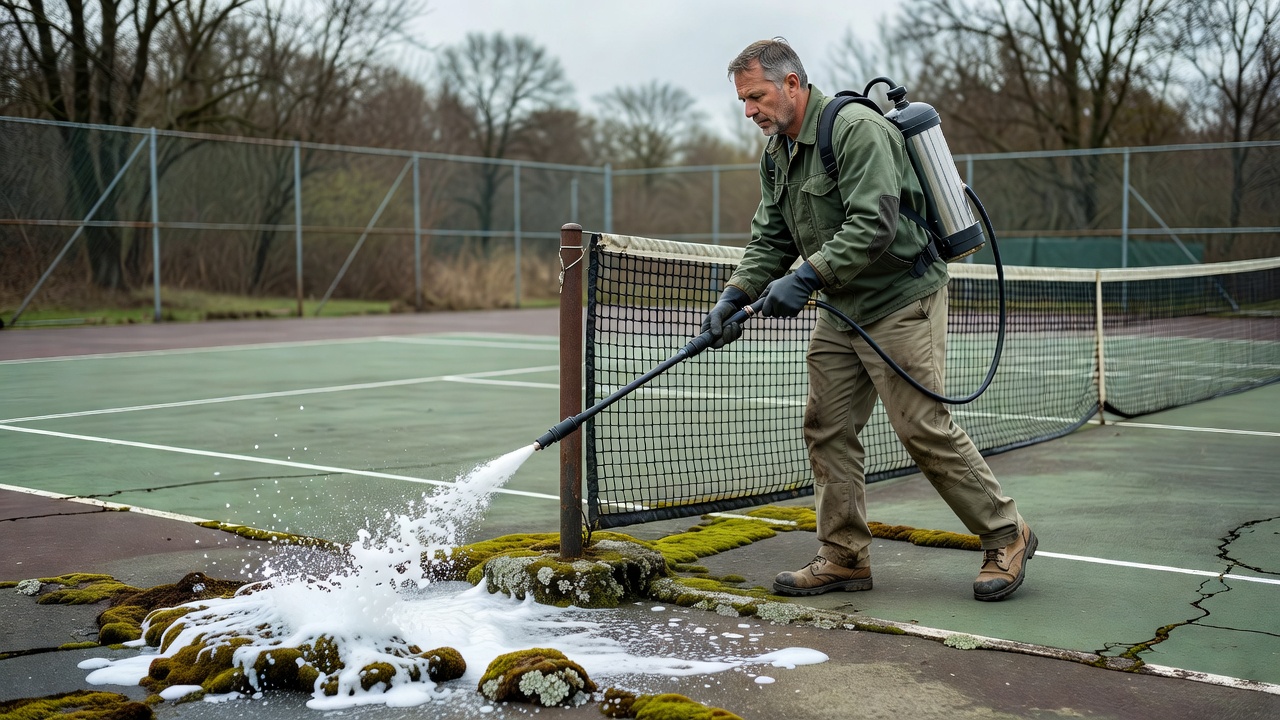
Across Atlantic and Central European regions, damp winters promote algal blooms and black lichen crusts. The single most common mistake clubs make is letting moss gain a foothold and then attacking it with an aggressive 3,000-PSI industrial pressure washer.
"Blasting an aging macadam court with a high-pressure turbo nozzle is devastating. It rips the softened bitumen aggregate right out of the surface, leaving behind pockmarks that hold water and accelerate stone fretting. Chemical remediation must precede gentle mechanical washing."
The correct procedure is chemical and preventative:
- Spring & Autumn Biocide Applications: Apply a specialized, environmentally compliant quaternary ammonium biocide using a low-pressure agricultural boom sprayer on a dry, calm morning.
- Allow Natural Die-Off: Let the chemical break down the algal cellular wall over 7 to 10 days until the vegetation turns brown and powdery.
- Gentle Rotary Surface Extraction: Use a dual-head rotary cleaner operating at under 1,200 PSI with continuous vacuum extraction to rinse the dead organic debris without abrading the asphalt matrix.
Building an Honest Sinking Fund
How much should a club allocate each year to court maintenance? While exact contractor rates vary across European jurisdictions depending on raw material hauling costs and aggregate availability, prudent asset management calls for allocating between 4% and 7% of the original court construction value into an untouchable capital reserve each year.
For a standard two-court facility, amortizing this sum over an 8-year resurfacing window ensures that when the time comes to patch cracks, prime the slab, squeegee two coats of textured acrylic, and re-stripe baselines, the funds are already waiting in a secure interest-bearing account.
Seasonal Protocols: Autumn Leaves to Summer Heat
Daily and seasonal habits dictate whether a court lasts 6 years or 12 years:
- Autumn Leaf Management: Wet leaves contain tannic acids that react chemically with acrylic pigments, leaving permanent dark silhouettes. Clear leaves twice weekly using electric blowers with soft rubber tips.
- Winter Snow Removal: Never scrape ice or hard-packed snow using metal snow shovels or blade tractors. The metal blade will slice through acrylic wear coats. If a court is frozen, let it thaw naturally, and ensure perimeter drainage paths are clear of snow berms.
- Footwear Regulation: Enforce non-marking, herringbone or omni-court sole policies. Running shoes with aggressive knobby trail-treads tear up fresh coatings and grind abrasive sand into the acrylic matrix.