Spend five minutes at any European club built in the late 1980s, and you will recognize the symptoms: rusted bottom wires, chain link sagging like an unstrung racket, and corner strain posts leaning precariously inward under tension. For decades, traditional roll-out chain-link fencing with tensioners and top rails was the default installation across Europe. It was inexpensive, lightweight, and simple to put up. But it also vibrates loudly when hit by a tennis ball, snags loose clothing, and stretches irrevocably over time.
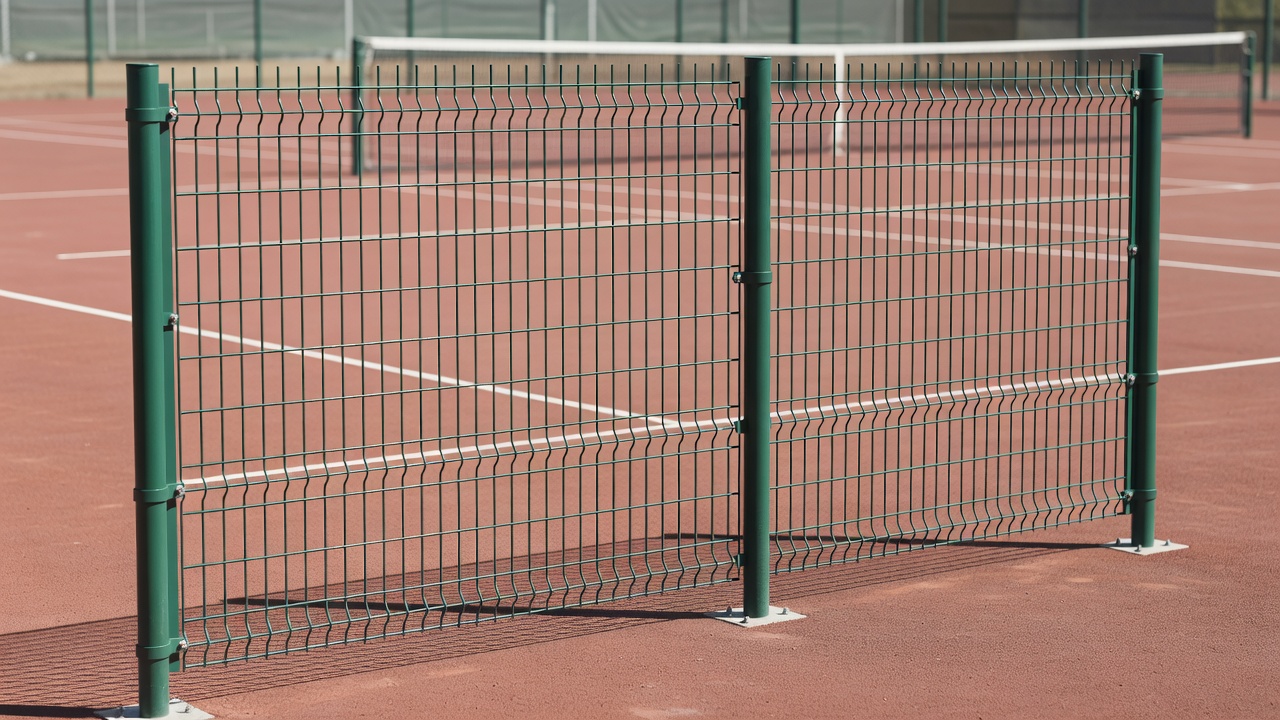
Today, restoration consultants are replacing tired chain link with rigid twin-wire panel systems (often referred to as 8/6/8 or 6/5/6 welded mesh). Understanding the structural differences between these two enclosure philosophies will save your facility from repeat post-hole excavation a decade down the line.
Chain Link vs Rigid Twin-Wire: What Belongs on Your Perimeter?
If budget is strictly limited, plastic-coated galvanized chain link remains viable. However, if you are planning a full 20-year renovation cycle, rigid panels offer distinct operational benefits:
| Fencing Type | Impact Resistance | Windscreen Suitability | Acoustic Rattle |
|---|---|---|---|
| Traditional Chain Link (45mm/50mm mesh) | Elastic deformation, tends to bag after repeated baseline impacts. | Poor. High wind load deforms line wires and tilts standard intermediate posts. | High. Shakes and rattles audibly whenever struck or caught by gusts. |
| Twin-Wire Welded Panels (8/6/8 or 6/5/6) | Extremely high. Dual horizontal wires resist ball rebounds and human impact. | Superior. Rigid posts handle dynamic shear loading from heavy banners. | Minimal. Neoprene isolation dampers and continuous clamp strips eliminate buzzing. |
Height Profiles & Step-Down Perimeter Layouts
Traditional courts were often enclosed in uniform 2.75-meter (9 ft) or 3.05-meter (10 ft) fencing around the entire 36.57m × 18.29m perimeter. While this catches every wild smash, it creates an institutional, caged feeling that isolates spectators and cuts off natural sightlines from clubhouses.
In modern European refurbishments, step-down layouts are increasingly popular. Here is how the geometry typically works:
- Baselines & High Corners (3.0m): Full-height fencing extends 3 to 6 meters from the corners along the baselines where misplaced groundstrokes fly at high velocity.
- Sidelines (1.0m to 1.2m): Along the side runs parallel to the net, the fence height drops down to approximately 1.0 to 1.2 meters. This allows spectators, coaches, and socializing members to view play over the rail, while still containing low skidding balls.
Wind Loadings & Windscreen Engineering
Many club committees decide to hang custom printed windscreen banners (or privacy screening) to reduce glare and eliminate wind gusts without consulting a structural engineer. This is a notorious cause of fencing failure.
"A solid banner turns an open 3-meter fence into a colossal sail. During an Atlantic gale, the overturning moment at the post base can exceed several thousand Newton-meters, either snapping the post at ground level or cracking the perimeter concrete kerb."
If you intend to install windscreens, your restoration specifications must include:
- Air-Permeable Mesh: Specify 50% to 70% wind-passage open mesh fabrics rather than solid vinyl tarps.
- Upgraded Post Wall Thickness: Heavy-gauge rectangular hollow section (RHS) posts (e.g., 80x60mm or 100x50mm with minimum 3mm wall thickness) instead of thin round scaffold tubes.
- Foundation Depth: Concrete footings augered to at least 750mm to 900mm depth, positioned entirely outside the active playing slab to prevent root-like frost heaves from disrupting the playing asphalt.
Gates, Access Compliance & Maintenance Hardware
Do not treat gates as an afterthought. A single 900mm pedestrian gate is insufficient if your club groundskeeper needs to drive a utility tractor, sweeper, or heavy roller onto the court for annual decompaction. Restoration plans should always incorporate at least one double-leaf maintenance gate (minimum 2.4 to 3.0 meters wide) equipped with ground drop-bolts and a heavy-duty padlock shroud.
For pedestrian gates, ensure latching handles are accessible from both sides, open outward away from the playing court to prevent high-speed collisions, and feature magnetic or hydraulic self-closing latches to stop loose dogs or wildlife from roaming across the pristine surface.