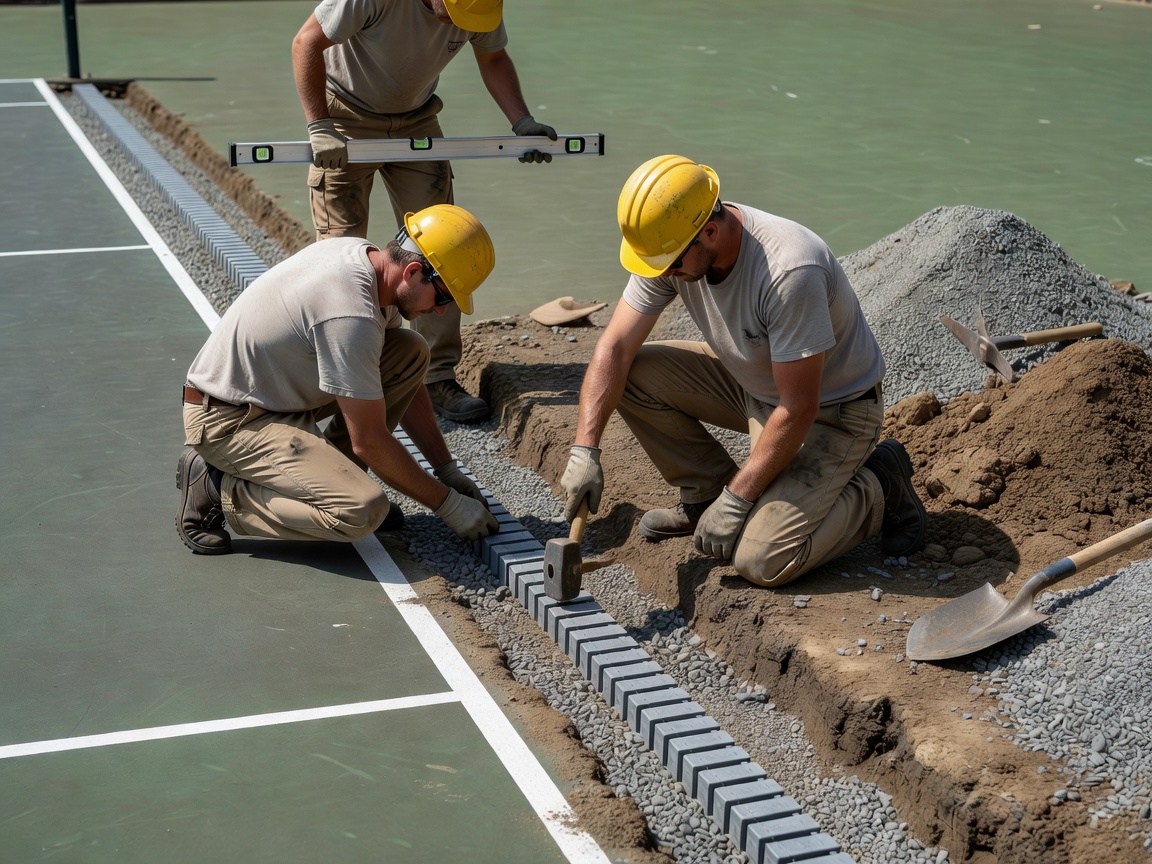
Every court restoration job starts with a quiet truth that club committees often prefer to overlook: the colourful top coat you see on television is barely two to three millimetres thick. It does not provide structural strength, nor will it magically level out a sub-base that has begun sinking into saturated clay. What a high-grade surface system does deliver is uniform ball bounce, predictable shoe-surface friction, protection against moisture ingress, and thermal UV stability.
Before ordering drums of pigmented acrylic or unrolling synthetic turf rolls, you have to diagnose what is going on below your feet. A surface that has peeled away in sheets almost always suffered from moisture vapor pressure from below or poor mechanical adhesion to an unprimed, oily asphalt base.
Comparing Common European Playing Systems
Depending on your geography, member demographics, and maintenance budget, different systems make sense. There is no single "best" court—only the right engineering compromise for your club's rainfall, freeze-thaw exposure, and player joint comfort.
| Surface System | Typical Bounce Speed | Impact Absorption | Key Maintenance Demands |
|---|---|---|---|
| Porous Open-Graded Macadam | Medium-Fast | Low (Rigid base) | Moss treatments, periodic pressure wash, polyurethane color coating every 5–7 years. |
| Multi-Layer Acrylic Hard Court | Medium to Fast (Adjustable silica mesh) | Low to Moderate | Squeegee birdbaths, keeping drainage clear, recoating wear lanes every 6–8 years. |
| Cushioned Acrylic (EPDM / Rubber Mats) | Medium | High (15%–24% force reduction) | Gentle wash cycles, strictly non-marking shoes, specialized patching if punctured. |
| Synthetic Clay / Infilled Carpet | Slow to Medium-Slow | High (Slide dynamics) | Daily mat dragging, periodic red ceramic sand top-ups, seasonal deep decompaction. |
The Chemistry: Acrylic Resurfacers & Textured Slurry Coats
Modern acrylic systems rely on 100% acrylic latex polymers suspended with water, selected pigments, and carefully graded round-grain silica sands. The roundness of the sand grain matters tremendously: angular silica acts like sandpaper, shredding tennis ball felts and causing aggressive skin grazes when players take a tumble. Round silica sand provides clean micro-texture without sharp edges.
The standard restoration sequence involves three distinct layers:
- The Acrylic Resurfacer (Leveling Base): Mixed with coarse silica sand (around 40 to 60 mesh), this black or neutral formulation fills the micro-voids in freshly patched asphalt or shot-blasted concrete. It acts as the mechanical bridging layer.
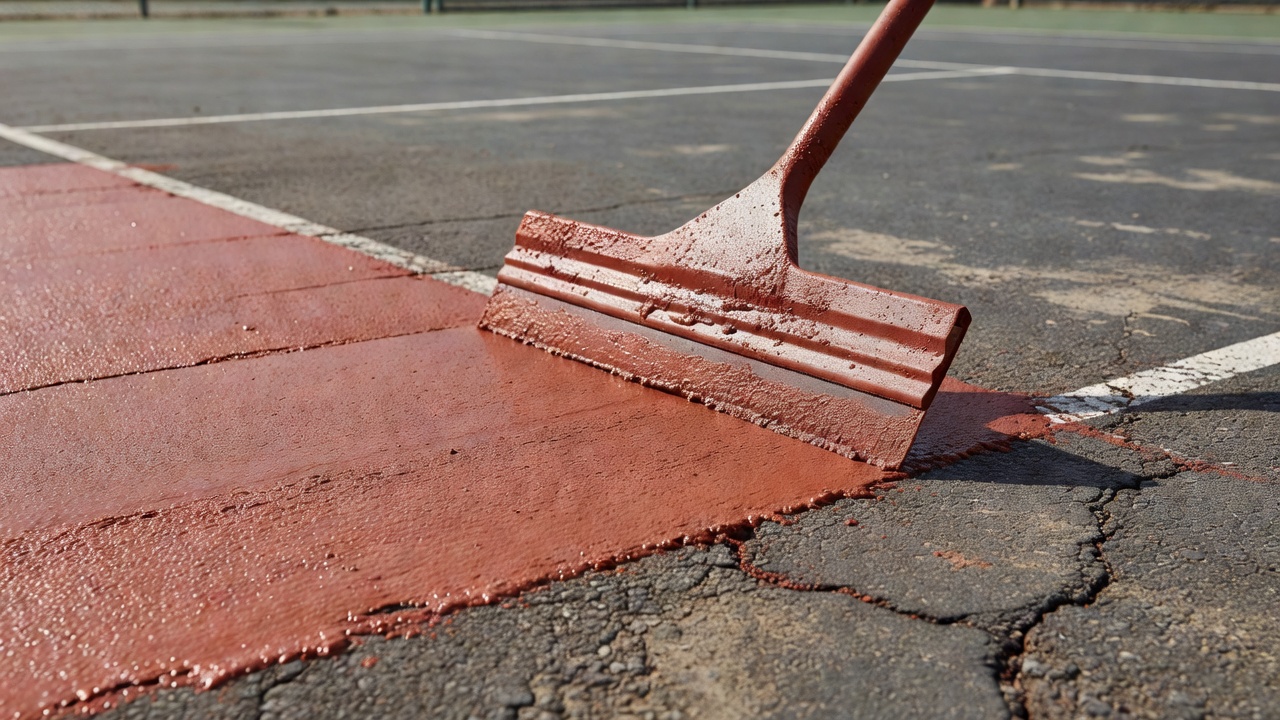
- The Textured Color Base Coats: Typically applied in two separate coats with flexible 70-durometer neoprene squeegees. These coats contain finer sand (70 to 90 mesh) and determine the court's pace rating according to the International Tennis Federation (ITF) pace categories.
- The Finish Color & Line Marking: A sand-free or micro-sand finish provides intense colour saturation and UV shielding. Crisp white baseline markings are taped with laser or manual string lines, primed with clear line-sealant to prevent paint bleed under the tape edges, and painted with textured 100% acrylic line paint so the lines bounce and grip identically to the rest of the court.
"If you paint lines with untextured gloss exterior masonry paint, players will slip whenever their shoes hit the chalk line during damp autumn mornings. Texture uniformity across lines and field is non-negotiable for competitive safety."
Porous Asphalt (Macadam) vs Non-Porous Hard Courts
In the United Kingdom, Ireland, and Northern France, open-textured porous macadam reigns supreme. The reason is simple: rainwater passes directly through the wearing course into an open crushed-stone sub-base, allowing play to resume ten minutes after a heavy cloudburst. However, this porosity creates a hospitable nursery for algae, lichen, and moss. Over time, organic matter rots inside the pores, freezing during winter frost and popping the aggregate loose—a phenomenon known in the trade as fretting.
Conversely, in Central and Southern Europe, impermeable hard courts laid on reinforced concrete or closed asphalt are standard. These courts require strict 1% diagonal or side-to-side cross-fall slopes to drain water off the perimeter. If birdbaths exist—areas where water pools deeper than a two-euro coin (roughly 2.3 mm) after one hour—they must be patched using specialized acrylic patch binders blended with Portland cement and fine sand before full resurfacing.
Factors Influencing Expected Service Life
A well-executed resurfacing job should last between 5 and 9 years before requiring a fresh wear coat, provided the underlying slab remains structurally sound. The factors that shorten this lifespan include:
- Tree Canopies & Pine Needles: Acidic sap and rotting tannins break down acrylic polymers and stain coatings indelibly.
- Groundwater Hydrostatic Pressure: High water tables pushing moisture upward through the concrete cause osmotic blistering.
- Improper Squeegee Pressure: Uneven application results in thin spots near service line baselines where pivot footwork rapidly rubs the pigment away down to black binder.
Cost and Planning Considerations
When drawing up a financial proposal, clubs must budget not only for the raw materials but for extensive surface preparation. High-pressure rotary cleaning, mechanical scarification of flaking paint, crack elastomeric stitch-taping, birdbath levelling, and two days of clear weather with temperatures above 10°C are essential. Attempting to apply acrylic slurries in damp October weather will cause milky curing and eventual delamination.